Direbane is an abode to share artifacts, simulacra, histories, and other items of note related to ongoing years adventuring.
*** DROP BOX ISSUE *** APOLOGIES, SOME LINKS ARE MISSING AND SLOWLY BEING RE-ADDED!
Showing posts with label Arduin. Show all posts

Tuesday, November 25, 2025

Splendid Isolation

(My original Judges Guild Judge's Shield (1977), DM view.)

Almost always I have used a dungeon master shield. 
  • In 1978 I picked up the original first published Judge's Shield by Judges Guild. This was really made for OD&D using the Greyhawk supplement, but it worked for our D&D gane until the Dungeon Masters Guide was released around the summer of 1979. (I made a canary yellow Advanced Labyrinth Lord screen in honor of my old and worn Judges Guild screen.)
  • During this period of the late 70s through the 80s is was also common for Dungeon Master's to just use gatefold record albums. This did not provide any helpful tables, but did hide the DM's notes and often the record albums were chosen for their trippy art.
  • Later (not sure when) I acquired or most likely shared the T$R AD&D (1st Ed.) Dungeon Master's Screen. This is probably the most classic and well known screen, even had a separate 2-panel screen just for psionics!) 
  • When I restarted our game with new rules in 2004 I used the Ver. 3.5 D&D Deluxe Dungeon Master's Screen which was my first landscape paneled screen (my older screens basically had panels in portrait orientation). I really enjoyed being able to see over the screen better without having to stand up.
  • When I developed a 3rd Ed./AD&D hybrid rules we used in our game starting in 2012 I found the original 3rd Edition DM screen from 2000 and just clipped a whole bunch of alternate tables on top the screen.
  • During 2018 when we switched to a modified 5th Ed. I used Dungeon Master's Screen, Reincarnated (2017) which was the first screen I used in game play that was hardbacked instead of cardstock (4th Ed. had the first landscape/hardback screen I ever purchased, however we never ran our campaign in 4th Ed.). This was a superb improvement, especially when players in our game "sieged the DM" by launching volleys of dice attacks. The hardback screen repelled dice attacks where the cardstock screens often fee. I ended up over time covering this screen in stickers.
  • When we switched to Advanced Labyrinth Lord retro-clone in 2019 I made the aforementioned canary yellow Judges Guild tribute screen.
  • I also created homemade ref screens for Arduin games I've run for Green Hell in 2022 and a more generic Arduin screen in 2023. And also made a little mini-screen for Lamentations of the Flame Princess off of art for a future screen that hasn't yet been published.
  • During 2024 we first started our new 5th edition campaign I used the 5e screen from the 5e Wilderness Kit (the screen art is very cool), then when the 2024 revision books were released switched to the 2024 standard screen.
So what is the deal? I often have DMed without a shield, in particular by the 1990s when I knew the AD&D (1st ed) rules like the proverbial back of my hand. We also did a lot of "theatre of the mind" style games without miniatures and adventures were built out of imagination in real time improvised off simple maps and small sets of notes.

For me at least I enjoy having a wide variety of tables and notes for situations that might come up during a game. I am also often translating scenarios from different rules editions so want to make adjustments on the fly. Also cool and provocative player-facing art on a screen helps set the vibe a little.

And I guess I do like DMing from the far side of the table, away from the door, where a screen provides some privacy when I get up to pee and still have my maps and notes somewhat hidden. Unless someone wants to obviously sneak a peak.

Ha. mostly though, if I am being honest, when I am furiously going through a variety of materials trying to find that note or rules section or piece of a dungeon I am hacking for my campaign, it really is best for my players not to see that.


Saturday, October 11, 2025

Party Like It's 1979

 
(Art by Cynthia Sims Millan, 1978)

I've got my half-round combat and floating seconds initiative for the low-rollers. What else from golden games of yore can I cram into the most modern version of D&D?

We had fun using in our game the critical hit table from Arduin which, as often mentioned in many commentaries, is daft because over time odds are your PCs are going to suffer many more double natural 20s than any individual monster they are presently fighting. What happened over time is crit tables became more watered down (no more having a spine severed in one blow).

An excellent replacement is the Death and Dismemberment table by Zak Smith of Playing D&D With Pornstars. Basically, the Death and Dismemberment table is an alternative to death saves in 5th edition. Once a character falls below 0 hit points, a single roll is made with a variety of modifications against a table ranging from the very bad (hey, my spine can be severed again!) to characters getting that second wind and single hit point that comes with it.

The fairness of a Death and Dismemberment Table is that someone has to already drop to zero hit points before it's rolled on. To get there you use the standard critical hits of double damage (although I am experimenting with an exploding damage die on crits). This method is more fair to PCs, but still leads to broken bones and scars.

Another thing, that I am somewhat on the fence about, are divine intervention rolls. These used to be pretty common back in the day as a last ditch before character death or TPK, although it doesn't seem to be very common in the same way nowadays. The latest edition asking for divine intervention and expecting results is limited to 10th level clerics receiving a free cast of 5th level or lower spell or a 20th level cleric getting a free wish. And looing like RAW the cleric can call upon their deity as often as they meet the rest requirements.

I kind of like the idea that only the divine magic practitioners may call upon their personal deities, I had several religiously ne'er do well characters who asked for divine intervention without even listing a deity on their character sheet. But I still thing there should be some rules a'la the 1st ed AD&D Dungeon Masters Guide (pgs 111-112) that deities may refuse or even be angered by excessive requests for extra special boons. I have a table that expands on the original olden rolls, and will be working on something to make the clerical divine intervention interplay a little more robust. And perhaps offer some kind of an expansion to any character that regularly practices their religious faith.

What other gems have I tried to maintain over the years...? Ha, I do like weapon to-hit mods by armor type (although I've become attached to Anthony Huso's idea of tying the modifications to numeric base armor class sans dex & magic modifiers). I noticed character's age, height, and weight tables are missing from the latest versions. Ditto for eye and hair color. I mean, you could just pick an abnormal color - but those special Arduin tables were fun too. 

Saturday, September 6, 2025

A Cascade of D&D

Ha, so all our games were not drug and alcohol infused debauchery.

Technically speaking, our first game system was from the Dungeons and Dragons Basic Set by J. Eric Holmes. Holmes uses a very simple weapon speed system - Daggers get 2 blows per round, long swords 1, and 2-handed swords 1 every 2 rounds. When the Advanced Dungeons and Dragons Players Handbook came out the summer of 1978 we naturally assumed the 'speed factor' of weapons indicated the number of segments within a round it took to wield any particular weapon.

There was no AD&D Dungeon Masters Guide until sometime during the summer of 1979, and I don’t believe I ever read that book straight through. We just began using the updated to-hit and saving through tables, magic items and such, but never got into the nitty-gritty for what we thought we already knew. (Ha, except Dr. John PhD may have tried to explain the DMs Guide version of speed factor, lo by then the drugs were beginning to kick in.)

Pre-Blipping Campaign Dr. John PhD ran our 8th grade Greyhawk campaign from the formal dining table in John's family’s front room. I began to DM some when we hit high school and at the same time began branching out into the Wilderlands of High Fantasy City State of the Invincible Overlord campaign and started integrating the Arduin Grimoire original trilogy into our rules. (We also I think never played at John's again, his mom had a better nose than mine for weed!)

Our D&D combat was FAST, segment by segment actions with multitudes of attacks per 1-minute rounds. Often decisions had to be made in half a melee round or less.

Post Blipping Campaign we never quite attained our old style of play. Ha, #1 was because previously we were not plying rules-as-written (the DMs Guide strangely only used speed factor for initiative). But also, #2, because 3e, 3.5, and 5e (including most all of the reputed “Advanced” retro clones) were based on a style of play where AD&D was cropped onto the Moldvey/Cook BX D&D or the Mentzer BECMI which did away with segments of melee rounds and used only gross action and gross movement.

Rather than our simulation where actions were subjugated to TIME, i.e. the clock would be ticking and the PCs and monsters had to fit their possible and variable duration-based actions within the confines of the passing seconds, the new versions has time subjugated to the ACTIONS of each participant, i.e. everyone gets their move and their attack and at that moment 6 seconds (or 10 seconds depending on the version) duration had passed.

A rundown of our main campaigns pre-Blipping Campaign were:

    • Dr. John PhD’s “Greyhawk” (1977-1982) – Pretty much centered in the Pomarj, we went through most all the classic AD&D modules: Hommlet, the Giants and Descent into the Depth of the Earth series, White Plume Mountain, Tomb of Horrors. This campaign ended after we graduated high school when Dr. John headed of to UC Santa Barbara to become a chemist.
    • Matrox Lusch & Others “Wilderlands of High Fantasy” (1979-1984) – I piggy backed several T$R modules like the giant series, but also ran Tegal Manor, Thieves of Fortress Badabaskor, Dark Tower, all 3 city states (Invincible Overlord, World Emperor, and Tarantis) as part of my main campaign. I also ran the some of the Judges Guild one-offs like Citadel of Fire, Sword of Hope, and Under the Storm Giant’s Castle. The Wilderlands was somewhat of a shared campaign as my brother Sumerled ran Modron and Verbosh and our friend Spacin Jason would run the Arguin dungeons there. In 1982 Judges Guild lost their license to publish “official” AD&D materials and started to use this “Universal” format which was a pain in the ass. Plus a lot of Judges Guild had been disconnected from the Wilderlands setting and sort of silly even before they lost the license.
    • Matrox Lusch “Krull” (1980-1985) – To fill in the gaps of the Wilderlands I would just make things up, ha, with the problem being the monsters would usually “cry uncle” when I was too tired to carry on. So I was accused of “making things up” (true) and also railroading (somewhat true when I was falling asleep in the wee hours). I had written up a dungeon during probably 1979 or so based on the “Pirates of the Caribbean” ride at Disneyland (one of my favorites), and began to spread out from there into other regions of my game world “Krull” (well before the 1983 movie of the same name). Ha, the problem was I still made shit up – I mean it’s D&D and I loved a sandbox and would do these on the fly all the time.
    • J.A.S. “Drow Mag-Tec” (1986-1987) – This is seriously as close as I got to the 80s “Satanic Panic” (our group was so insulated we never heard of that at the time). J.A.S.’s wife watched the 700 Club (Jim Bakker & Tammy Fay Bakker) who did a show on the evils of D&D. So his wife wanted J.A.S. to stop playing that evil magic game immediately. John compromised by developing a setting with no other religions besides the Mycretians (a Wilderlands quasi-Christian-type religion) and the main enemies were the Drow who used something called “Mag-Tec” which was basically sci-fi technology. All the characters were fey (our party was a brownie, a pixie, and a leprechaun) so we had a bunch of innate magical abilities, but no spells. Ha, we were all technos.

By the time our Post Blipping campaigns began in 2004 I had sobered up and wondered what happened to all the friends I used to have, so toward the end of 2005 corralled everyone into version 3.5 by anonymously sending them copies of the new Player’s Handbook. (Also, since Dr. John PhD had moved off to Oregon with his Physician wife I was the de facto DM.)

    • Matrox Lusch “High Fantasy” (2005-2011) – This campaign was set in the Wilderlands, but the party did travel around the planes quite a bit. Timewise I don’t think there was any time travel, but I did have the party visit other settings such as Grayhawk and Arduin during different time periods than when campaigns in these settings typically started. Tragically in 2011 we lost our long-time 30-year gaming friend, Postman Bob (and a friend of J.A.S. longer than that). This sad event resulted in the campaign ending as we decided to roll up new characters rather than carry on without Bob. In addition to Wilderlands products, among the other published works I leaned on for this campaign were Red Hand of DoomCity of the Spider Queen, Expedition to the Demonweb Pits“The Lich-Queen’s Beloved” three-magazine Incursion event featured in POLYHEDRON #159, DRAGON #309, and DUNGEON #100. The overarching plot was an attempt by Tharizdun to free itself from Prime Material chains.
    • Matrox Lusch “Blipping 2” (2012-2019) – In this campaign the characters were unstuck in time and space, but it was due to a mysterious orb they discovered (or possibly revealed itself to them) on Sigil, and the orb transported the party around. We also did not rotate DMs in this campaign, but I visited many of the locations and NPCs from our Blipping Campaign. I also developed a set of rules for this campaign that was a blend between v3.5 and AD&D. Fast forward to DunDraCon in 2018, I ran an “official” game where players could bring in any D&D version of a character they wished, hoping folks would bring out some old high-level characters they hadn’t played in years. However, every single player in that game brought a 5th edition character. Then, at our regular game that Saturday night at the Con the group was short a cleric and advertised for one – every interested person brought a 5th edition cleric. The writing, I saw, was on the wall that 5e had settled in as the standard. I put together a hand-crafted 5e adding some modifications such as critical hit tables and psionic abilities and we ran this modified 5th edition for almost 2 years.
    • Various “New Old Weird World” (2019-2023) – I was fortunate to run a character in a scenario Jeff Rients was testing out and had this realization I had not run a character since I became sober 15 years earlier! I kind of overreacted and told my group I wasn’t going to run the campaign solo any more, that I was going to run a character, we were going to rotate DMs, and we were going to run an AD&D retro-clone (we ended up using Advanced Labyrinth Lord with some of my collected mods). This was more truly a Blipping 2 campaign, although we used only single DMs for 3 sessions each. After the campaign surviving through Coved that campaign took a hiatus when we had all kinds of troubles getting the group together, and were missing some fun players like Sumerled and Random Addison who were extremely opposed to online D&D games. These are the characters I am running (in-person) my End of Time Extravaganza for up at J.A.S.’s mountain abode next October 27, 2025. 

And now I've ended up co-DMing and DMing two 5th edition (2024) campaigns: The Psychedelic Deadlands / Dreamer of Dreams campaign online with Dr. John PhD, and the new "5th Iteration Wilderlands" in-person campaign.

My next task is to understand how I can break down the variety of things folks can do in a 5th edition melee round, and to see if I can get the game subject to time again rather than time subject to the actions. Perhaps it's a difference with no meaning - but I am digging in. It has been almost 15 years since we all last played an official Dungeons & Dragons RAW. Until next week I hope you go easy.

Friday, August 15, 2025

The Astral Asshole


The Blipping Campaign, Friday November 29, 1996

Magic Item of Note: Mithral Torch (+1 to Wisdom, True Sight line of sight, it burns twice as bright as a normal torch (80 feet). Once per month everyone within the light has protection from evil and undead within the light are effected as if by sunlight.)

Game Background Music: Old Dick Dale (I think), Ministry, and the Steve Miller Band.

So from where J.A.S. is indicating in the Deities and Demigods we were battling Cthulhi Mythos, namely Nyarlathotep in this session. Plus it seems to have some friend with him. It seems creatures from the Far Realm (called the “Aberrant Realm” in my game) are fleeing from something even worse The Old Ones.

In my pre- and post-End of Time scenario then the New Old Weird World adventuring party (or parties) could encounter two Illithid time-traveling starcrafts, one from the Illithids preparing to travel backwards in time to escape the End of Time event and the second the first Illithids’ ancestors who traveled forward in time to escape the Githyanki. Both are aware of the impending End of Time event and presumably would be aware of involvement by the Old Ones.

The Cthulhu connection from the Blipping Campaign is interesting because the New Old Weird World campaign also intersected with some Cthulhu mythos after escaping from a future Sigil. We departed from the besieged Cthulhu lands by way of resetting the mysterious “Great Portal of Broya,” ending up in an unstuck, time and space-wise, Tegal Manor.

Now I have a couple tricks to play with:

1. One is my thoughts of using the Decanter Room extradimensional space broken through to the Shadow Plane (a colloquial name, not any “official” Plane of Shadow); and

2. How the Old Ones intersect with the End of Time even and their essential indifference to the rest of reality.

Friday, July 4, 2025

Slipping Time in Dungeons and Dragons (Another Essay Wherein It Is Good Players Do Not Read My Blog)


I have devoted lots of hours (weeks, months, years, decades) toward the Dungeons and Dragons game, right up there with jobs, and only essential compensation having been companionship with my fellows of the game. (There is also a distinct possibility based on personal and family history I am somewhere on the spectrum for autism and that D&D helped me build self-esteem and rewrite my personal narrative, ha, so there is that too.) The campaigns I run I attempt as best I can to all fit together in strange and wonderful ways into a single overarching setting. This banks time I can re-use to construct narrative background and provides great rewards forming common existential bases for the variety of adventuring party settings and events.

However, several campaigns over the past 5 years have reached a point where they have begun to approach and even wrap around an “End of Time” event where I feel the need to at least make an observational leap to what happens at the “End of Time” for my game.

The caveats are that my observations must be somewhat in harmony with how the still-developing adventuring campaigns have already “wrapped” around the end of time. And also be as best as I can manage philosophically consistent with the game Multiverse which in various magic and lore has already co-signed time travel itself as a thing. That said, I am not too much worried about specific outer plane Gygaxian metaphysics because what I imagine is a moment where time and space do, or at least seem to, cease to exist – temporal movement, the Multiverse, and all related planes are gone… or perhaps almost gone. Of necessary the event itself is beyond experience for any planar and extra-planar beings or spaces.

****NOTE: I have used in-game the apocalyptic description for the “End of Time” reckoning from Star Rovers RPG, co-written by David Hargrave, which I loosely pasted over some Judges Guild Traveller background… 

For Time has begun to run out. The Hurrakku — they who would gnaw their way through a starcluster and leave nothing in their wake — had already starswarmed. And even though they were still more than forty galaxies away, they were headed in the Empire’s direction.

But they were only the messengers of a great doom. What goaded the Hurrakku onward was the fear of impending annihilation. There loomed behind them an expanding, starless, blackness — A rift in the Space/Time fabric grown so large that it consumed the Past, the Present, and the Future. This was the Final Darkness that Would Cancel Everything!

And also the description from the 3.5 supplement Lords of Madness that Illithids existed “… at the end of time.” “Facing annihilation,” Illithids “… traveled to the past, arriving roughly 2000 years before the present in any given D&D campaign.” Mind Flayers are almost always lurking in the background of my campaigns.

Otherwise, without so far having researched in any depth folks smarter than me on the subject, either in a game sense or our own “real world” physics, I am attracted to 4 possibilities that might fit given I’ve already gamed adventuring parties whose adventures at least seem to have wrapped beyond the end of time relative to parties prior to the “End of Time” event.

Full Stop / “Dead End”: The Multiverse “births” then events unfold in a singular routine. Time travel past and forward is unable to change events because appearances in the past/future have or will have already happened or deigned to occur. This is Robert A. Heinlein’s “The Door Into Summer” version and how I generally structured time travel in my game without having yet added the “End of Time” epistemological considerations. But with time travel another possibility arises for perpetuating the game Multiverse...

The Loop / “Roly Poly”: The existent “wrap” in my game may indicate time folded back on itself as characters or beings head back in time before the “End of Time” event, but appear early in the generation of the Multiverse such that it only seems new. Yet ultimately, given “The Door Into Summer” the Multiverse unfolds exactly the same as a result of no change with the inputs (i.e. anything that happens in the past has already happened). A game could have new characters and delve deeper into incidents for how this or that history actually occurred – but characters would have no agency to change actual events that are “known,” either in game or meta–game. That is sort of a bummer given my sanboxxy sensitivities, which leads to my next possibility…

Re-Birth / “New Big Bang”: Something nature to the “End of Time” event, or perhaps some interruption or alteration or missing/hidden piece of the Multiverse re-births into a new multiverse, sort of a new Big Bang with new possibilities, and explains the formation of a Multiverse some ways similar to, but not exactly same or maybe very different than, the former Multiverse. There is also a possibility of entities from the old multiverse to jump through time over the “end” and “bang” events into the new Multiverse.

Of course, it could be that “The Door Into Summer” set history is not the nature of the Multiverse, leading into the 4th possibility I consider…

Temporal Branches / “Time-Stems”: This is a William Gibson-esque infinite multitude of potential universal timestreams where time travel does not change the source Multiverse, but rather produces an alternate branch of time. While it is not possible to physically pop over from one time-branch to another, characters would still meet beings from their origin Multiverse altered only in the sense of their contact with different branches. Potentially an infinite number of Multiverses from which, as a result of cross contamination through time travel, it would be virtually impossible to discern which is the “real” Multiverse, or even if that really matters. 

Anyhow, that is a long explanation being the good news is that I do not need to answer any of these questions quite yet. I can preserve a timeline of my campaigns to date (below) to set some parameters, then just see what direction where go the present campaigns.


I have 2 campaigns on hiatus that both are approaching near the “End of Time” event that some of the players are encouraging me to run “tournament style” and the remaining campaigns I feel are post-”End of Time” event, so possibilities 1 & 2 seem to be excluded and I am leaning into possibility 3.

CAMPAIGNS TIMELINE

The years are 1st Year 0 relative to the High Fantasy campaign (where the time stuff began to loosely cohere), 2nd the Wilderlands Balozkinar’s Corrected Commoners Calendar (“BCCC”), and 3rd Greyhawks Common Year calendar (“CY” and “BCY”). Note that many dates are approximations.

--------------------------------------------------------------------------

-47,733 / -43300 / -47,158: Uttermost War comes to an end.
       |
       |
       |
-35,000 / -30567 / -34,423: During Century Wars of Domination Agent Smith arrives from early 21st Century Earth and is transformed into cybernetic unit 718552.
       |
       |
       |
       |
-2,000 / 2433 / -423: Future Illithids arrive in past.
       |
       |
-200 / 4233 / 376: Githyanki uprising, future Illithids disappear from past & Astral Plane.
       |
0 / 4433 / 576: High Fantasy Campaign begins in the Wilderlands, Blipping #2 Campaign begins in Sigil, Wilderlands of the Torment Nexus Campaign begins in the Wilderlands and a cursed scroll from the ancient Markab ruins in Ashenshaft and found in the library of the Wizard Korpauntarl transported the adventurers through time and dimensions in space to Cube World.
       |
1 / 4434 / 577: Blipping Campaign begins in Arduin. High Fantasy thermonuclear-like explosion resulting from Tharzadu'un traversing portal escaping to Arduin - Artaban/Codex of the Infinite Planes intervenese saving party; throws Blipping Campaign to be "unstuck" in the Multiverse.
       |
2 / 4435 / 578: Baron Uther of Blackmoor activates the “secret weapon” from City of Gods in Valley of the Ancients, unwittingly a massive terraforming device, and the planet Ghenrek IV is forcibly tilted from its axis.
       |
       |
4,000 / 8433 / 4,576: Blipping Campaign #2 arrives in future Comeback Inn.
       |
       |
       |
16,345 / 20778 / 16,921: Blipping Campaign #2 arrives in late 20th Century Earth.
       |
16,355 / 20788 / 16,931: Blipping Campaign arrives in late 20th Century Earth.
       |
16,565 / 20998 / 17,141: Blipping Campaign #2 arrives in late 22nd Century Demonic Earth.
       |
       |
20,000 / 24433 / 20,576: Space/Time Rift approaches Imperium, Blipping #2 Campaign arrives in future Ghenrek IV/Ghostring to discover Illithid Spelljammer which carries them to Illithid origin disc-world “Penumbra.” New Old Weird World Campaign adventurers also end up on Penumbra after visiting future Sigil and future Illithids depart the future to the past. 

--------------------------------------------------------------------------

Out of Time and Wrapped Campaigns
  • New Old Weird World Campaign: A flat disc planet (on the back of a turtle?) on pocket plane (post “End of Time” event) but passes through a far future Sigil to Penumbra prior to Illithids fleeing (pre-"End of Time" event)
  • Wilderlands of the Torment Nexus: Wilderlands of High Fantasy on Prime Material Plane (Pre-"End of Time" event), sent to Cube World on pocket plane (Post “End of Time” event)
  • Psychedelic Deadlands / Dreamer of Dreams Campaign: On Outlands and Prime Material Plane (Post “End of Time” event)
  • Wilderlands 5th Iteration: Wilderlands of High Fantasy on Prime Material Plane (Post "End of Time" event and pre-"End of Time" event???)

Friday, February 16, 2024

Perrin Conventions and Cinematic Death at DunDraCon #47

(George the Gnome Barbarian.)

Mere weeks after D&D turned 50 years old, DunDraCon 47 was held (should have been #49, exception years were DunDraClone in 1981 and the Covid shutdown year 2021), showing the gaming convention's roots with the world's most popular role playing game.

Friday night has been Arduin night for me at the con. Four of the past five conventions I've run a variety of places in Dave Hargrave's world (Caliban, Green Hell, Talismonde, Dead Watch Mountain). Hargrave eventually had his own rules system published, however, the first three volumes of the Arduin Grimoires from 1977 track very closely to the original D&D's first 3 booklets + supplements I-IV

My own gaming group from the beginning used Arduin's races, classes, tables, etc. as supplements to our 1st edition AD&D game which in the earliest couple years did not have the benefit of the Dungeon Masters Guide (and this tweaked our version of D&D for decades!). As a particular conceit of my convention games I have been attempting to run the Arduin DunDraCom scenarios from the original Arduin Trilogy rules-as-written (using the Arduin Trilogy compendium book by Emperor's Choice Games).

Now, Dave Hargrave in the original trilogy does have a simple no-roll initiative system where combatants basically count down in Dexterity order, with the twist that if a person's dex is twice (or even 3x) their opponent they receive 2 (or 3) extra attacks against them.

Historically our gaming group used AD&D's 1-minute rounds and their internal 6-second segments, reducing actions to discrete numbers of segments to get a more cinematic feel for the action i.e. the dragon will breath in 2 segments, what do you do? Now that we are gaming Advanced Labyrinth Lord's B/X-style 10-second melee rounds, it seemed a natural fit segments = seconds, but I hadn't stumbled upon a satisfactory method for assigning what tasks could be done in what time... until now.

I had heard about The Perrin Conventions by Steve Perrin of Chaosium and distributed at DunDraCon #1 back in 1976. All I really knew was that they were an early attempt to make D&D combat more in the moment rather than the wargaming-style abstractions where hits and damage were not individual swings, rather they were the abstract results from a period of time (often a minute) of melee.

Steve Perrin and just about all of the early west coast D&Ders were members of the faux-medieval Society for Creative Anachronism formed out of UC Berkeley in 1966. Their experience with combat within society events didn't sit right with the OD&D rules, so Perrin endeavored to create more realistic rules in his conventions. Perrin finally published The Perrin Conventions in All the World's Monsters, Volume 2.

Low and behold, I happened to be looking through a copy of All the World's Monsters, Volume 2 for the Pirates of Hagrost game I am running, and right in the first sentence" "SEQUENCE OF PLAY - Melee Round, In a melee round, (which takes up 10 seconds)" (emphasis added) These conventions are for 10 seconds rounds, same as we are using in Labyrinth Lord.

I worked up a version for our campaign that uses still the d6 initiative roll and also my interpretation of speed factor and incorporated the conventions into our supplement for Advanced Labyrinth Lord, New Knights of the All Mind, and play tested the rules at my Friday night Arduin game at DunDraCon.

I had for the first time had a light turnout for the Arduin game, we had only 4 players when previously I had to turn a couple folks away each time. I had each player run 2 characters a piece and we had a blast.

Down at the final battle against the Hell Dragon when he was due to breath napalm breath all across the party, George the Gnome leapt on the dragon's back plunging in a 2-handed sword to divert the dragon's attention. As the dragon flew back down to dive into the magma lake and prepare another attack, our Star Powered metamorphized puma mage managed to read a scroll of part water (5 seconds) to expose only barren rock for the dragon to face-plant upon.

Alas, with 4 seconds to try and save George, there was nothing available to be done and, along with the dragon, George was smashed. (The dragon however had 6 hit points left and did return for a final blow...)

The cinematics of the scene were terrific, and with everyone running 2 characters each that they weren't too attached with, losing a character didn't mean you were out of the game. Great fun.
 

Wednesday, August 2, 2023

Pig Faced Ork Con 2023!


If you are down in So-Cal I highly recommend the Pig Faced Ork Old School Role Playing Game Convention set for Saturday October 21, 2023. This Fresno, CA area convention is a one-day gig in its 4th year and put on almost single-handedly by organizer and artist Tom Wendt. Tom dedicates this convention to introducing new players and sharing with the old ones original versions of classic table-top role playing games from the 70s and 80s.

The convention moves back to the Clovis Veterans Memorial District halls from the Fresno Woodward Park Public Library where it had been held in 2021 and 2022 (following a Covid hiatus in 2020).

I had a blast last year running an original-trilogy Arduin Grimoire ruled scenario based around "Sunken Ardwyr" with a kidnapped prince, stolen technology, thrall imposters, and outer-space aliens!

The convention is free (donations accepted) and Tom has in the past supplied doughnuts, pizza lunch, cupcakes, water, and a plethora of old-school raffle prizes.

Tom also personally creates evocative art for each game system to be ran. If you are interested in running a game or more info, you can contact Tom here: pigfacedorkosrpgcon@hotmail.com

(Kill Kitten Art Tom drew for my Arduin game)


Saturday, June 24, 2023

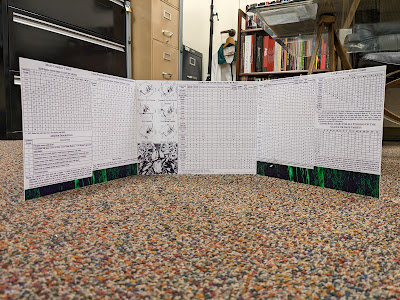
New Arduin Companion Ref Screen - Size Matters


So some of you may remember the OD&D Supplement IGreyhawk (ported into 1st edition) size small/medium and large damage charts for weapons. Often a weapon would do less damage or sometimes more damage depending on the size of the target creature.

Well, Dave Hargrave decided there should be more of that and developed his weapon damage tables versus creature size in hit dice ranging from 1/2 a hit die or less up to 30+1 hit dice or more with TWELVE COLUMNS of variable damage by weapon type.

I coupled this information into a reference screen along with the weapon attack adjustment charts by armor class (another OD&D Supplement I/1st edition adjustment where certain weapons had better or worse capabilities to hit various armor types).

A Dave Hargrave original table I included has weapon breakage charts when weapons (even magical ones) strike very dense material such as stone golems or dragons. Which, heh, since the table is there anyway has piqued my thoughts about what sort of Arduin scenario I should run next con game.

In 1988 I wrote up a completely non-canonical "Dragon’s Throat" in Dead Watch Mountain, listed in Arduin's Recorded Areas of Treasure and Doom as "a known dragon abode." I used mostly Arduin critters on encounters, except all the dragons are just regular D&D Monster Manual dragons.

I think if I remedied that with Hargrave's Arduin dragon types I just might have something suitable for gaming. Ha, except the "Dragon's Throat" is sort of Tolkien Hobbit-derived from the secret passage entrance to Smaug's lair. Another thing I'll need to tidy...

Sunday, February 12, 2023

Arduin at DunDraCon!

(Talismonde's Old Quarter looking east to Elric's Keep)

I am getting things ready for DunDraCon #46 running an Arduin version of "The Crypts of Arcadia" from Judges Guild The Book of Treasure Maps (1979) by Jennell Jaquays. The scenario runs with both random and some set encounters. I'm substituting in similish Arduin critters and little sci-fi twists.

The scenario will take place in Talismonde, Arduin's capital city. And I am super stoked with how my city map came out, just to get a grip of how the different sections of the city might be laid out.


There is more about the creation of a Talismonde map I'll have to post on later, right now it's plenty enough to broaden the sandbox as much as might be necessary. I learned running an Empire of the Petal Throne scenario years back, given a convention game's limited time letting the players roam is fine if they're having fun. (So dooo it.)

107 Talismonde Heist
Friday 6 PM in 146 for 8 hours
GM: Matt Morrison
Type: RPG
System: Arduin Grimoire
Edition: Original Trilogy
Players: 6
Provided: All characters provided by GM
Power Level: 5th-6th
Variations: Similar to and supplemented with OD&D and AD&D 1st Ed
Rules Knowledge: Useful
Game Content: Mainstream

Tuesday, December 27, 2022

Talismonde Heist

(Hopefully on the evening of Friday February 17, 2023)


"Notes from a clergyman’s journal, hidden vaults of Elven treasure, and an ill-fated excavation to burned-out depths of Talismonde’s undercity was a story told for years (after a few drinks) by the old man now dying of a bloody, hacking cough at an alley in the waterfront district of Arduin’s capital. But wasn’t there word of a hidden map?"

A loose collection of ne'er-do-wells stumble upon the treasure map of an old, dying thief and dare the rotting underside beneath the first true city in Arduin.

This is my entry for DunDraCon #26, about a half-century-old gaming convention out here on the left coast. I typically run a convention game Friday evening and then our regular gaming group runs Saturday night in Open Gaming.

I am coming off a pretty successful swampy-adventure Arduin game down in Fresno at Pig Faced Ork Con last October which followed a fun Green Hell jungle event at DunDraCon #45 last February 2022.

Anyone who has played D&D, in particular OD&D and 1st edition AD&D, will recognize the original trilogy Arduin rules as being very similar. Each game I have been a little better at throwing in more of the Arduin subtleties (for example Arduin's mana point magic system) which has been a lot of fun.

I should learn by mid-January or so if my game is able to be fit into DunDraCon's schedule and am keeping my finder's crossed.

***Arduin is a fictional universe and role-playing system created by David A. Hargrave. “The Arduin Grimoire” was self-published by Hargrave in 1977 and also two follow-up books in 1978, “Welcome to Skull Tower” and “The Runes Of Doom.” The three books became known as “The Arduin Trilogy.”

The original Arduin books added many interesting and notable features to fantasy role playing and were often treated by players as supplements to Dungeons & Dragons.

Wednesday, October 26, 2022

New Arduin Ref Screen


Now that Arduin is my "go-to" convention game, I put together a referee screen with more general Arduin player-facing art. Different than my previous screen which was more tied to the "Green Hell" jungle scenario I ran at the time.

The re-facing tables are all the same, although I have been assembling a rules cheat-book to capture many of Dave's particular rules that made Arduin a different flavor than regular OD&D (ha, some of Dave's variances were later somewhat adopted in other versions of D&D).

I had several pieces of art with different styles, the centerpiece being the art by Frank Kelly Freas from the cover of Complete Arduin. I created a unified motif by running each piece through the A.I. art generator "Deep Dream Generator" which created from the originals similar art in a new style that was the same for each piece.

Saturday, October 1, 2022

Aftermath of Pig-Faced Ork Con Arduin Game


The "Pig Faced Ork Old School Role Playing Game Convention" rolled into Fresno, CA and was a smashing success! 

Tom Wendt who runs the damn thing pours his heart and soul in - No reg fee, free giveaway contests and raffles, candy, waters, game judge badges, PIZZA, plus Tom does all the decorative art himself (not to mention advertising fliers) and secures the venue room at the Fresno County Woodward Park Regional Library.

I figure about 9 games were running including AD&D, Arduin (which I GMed), Holmes Basic D&D, Star Frontiers, Traveller, Weird Frontiers and more. Probably 50 gamers in attendance which is pretty good for a one-room con.

Emperors Choice Games and Miniatures asked if I would run an Arduin game there which worked out perfectly 'cause my partner Heidramor happened to be attending to a friend's baby shower in the area that day. I had run an Arduin game at DunDraCon last February. Each session is getting me better and better versed in the technical adjustments Dave Hargrave included for his game.

The end result is that now I have an Arduin-specific game bag set aside to run Arduin adventures.

I'll be back...

Friday, February 18, 2022

DunDraCon/Green Hell Post Mortem


Santa Clara Marriott with Eerie Green Parking Lights

Room 147

Player's Facing Screen Sides

Ref's Facing Screen Sides

Ha, I was busting my ass to make this multi-faceted Arduin time warping mystery scenario, then only had three players show up. Drat! But I am still super glad I made it out to the inaugural DunDraCon at the Santa Clara Marriott hotel.

It was all good though, I was able to use the random encounter tables and dungeon map then relocated the weird encounter and Mcguffin - right as rain! 

And while I was able to use my fancy "Green Hell" Arduin Ref's Screen with to-hit, saves, and turning tables, I do need to get more familiar with the Arduin Trilogy physical book. I have been so used to using the old PDF that I just search by term for what I am looking for rather than understand where information is in the context of the whole tome. 

We did it though - ran Arduin Trilogy right out of Dave Hargrave's rules. Har, except there are some bits, such as spells for instance, where the Trilogy presumes at that point you have access to some D&D.

All-in-all I had a great time, made new friends, and scoped out the new hotel for when my regular gaming group makes an excursion. Take aways: Be flexible, don't trip, and get the adventure started!

Friday, January 28, 2022

Green Hell at DunDraCon


109 Green Hell
Friday February 18, 2022 at 6 PM in 147 for 8 hours
GM: Matt Morrison
Type: RPG
System: Arduin Grimoire
Edition: Original Trilogy
Players: 5
Provided: All characters provided by GM
Power Level: 15th
Variations: enhanced w/OD&D, AD&D, B/X D&D, BECMI D&D
Rules Knowledge: Useful
Game Content: Mainstream

Lost in the tracks of the Green Hell is a bitter wound on the land that suppurates a poison that once almost slew the world. Here, in this salted land, something stirs once more to trouble the world...

Saturday, May 8, 2021

The Combat Discharger


I can't find out too much about Matan Thunder (except maybe he's this guy), the author of the probably the most gonzo magic item for the most infamously gonzo setting.

A little background...

There really were some evil Time Lords that attacked the World of Khaas. According to the Arduin Grimoire II, "Runes of Doom," it was all the Rune Weavers could do (after being much weakened from defending the world from Titans and Star Powered Mages 20,000 years earlier!!!) to seal the Time Lords in the Cavern of the Ancients located in the Great Rift.

The Nexis Points within the Kingdom of Arduin would not be discovered for another 8,000 years, and it was not until after 10,000 years of fighting the Wars of When (aka The Nexis Wars) that the Accords of Arduin came about. The time of the Arduin Grimoires is 1,211 years following the Accords.

So keep in mind that when Thunder refers to "The Arduin Consortium" and "Time Lords' Battle Sphere" these events must take place after the time of the Arduin Grimoires, likely a home brew and not Hargrave canon. BUT WHAT A FUCKING GAME!!!

(Also, crunchy note that Thundar seems to be using Arduin Trilogy/OD&D-style rules or maybe AD&D 1e.)

Anyhew, without further adieu, THE COMBAT DISCHARGER!

-----------------------------------------

"Combat Discharger" (by  Matan Thunder)

These devices were originally created by the Arduin Consortium as a means of conveying attack routines outside the Time Lords' Battle Sphere, while limiting the party’s potential to be injured in combat. These devices were much sought after inside the Consortium after their creation as they could serve as a very effective attack platform when present on any device with enough room for their user to project a specific attack sequence from. 

This 8’ diameter pad is 3” thick, and is made of a living symbiotic lifeform with the appearance of a brown leathery bouncy material backed that possesses a resiliency of steel. The primary function of this device is to provide for a distance attack system for melee weapons as well as any other type of attack. It can also serve as a mobile attack platform, as it can even fly and reach spelljamming speeds. 

The pad is activated whenever some creature places their feet on top of the device. This activates a 360 degree vision sensory field that can represent any place within 1 mile of the pad. The perspective presented is as if the user of the device were on the ground in the location currently occupied by an illusion (projected image) of the occupant of this device. The creature on the pad then may initiate any attack routine they have access to, which is then transmitted via a Remote Access spell affect. This conveys the attack to the site of the user’s wishes in precise synchronization with the user’s movements. 

The Combat Discharger will read/sense all movements of a creature on top of it, and it is then able to translate their attack routines with perfect precision to the target location through the remote access affect, as if the user were actually there. The only difference is that the damaging end of the attack materializes at the location within range Combat Discharger’s affect at the moment of the attack. This attack can be accompanied by an illusion of the attacker that the victim may key on to initiate counter moves, but there is no substance to this affect, except at the moment the Remote Access projects the attack to the victim. 

Device Sighting System The viewing sensors of the Combat Discharger come from 3 small black sapphire nodes spaced equally around the discharger pad (flawless stones worth 10,000 gold pieces each). These sensors have a combined projected image & programmed illusion working in tandem to project a point in the surrounding terrain within a range of 1 mile. These provide a view of the location present near the location of the viewing powers of the device. They are the source of all the use of the Remote Access Powers of the discharger, but the sensors are intangible, and they can move about at the will of the Combat Discharger to move about freely at the users wishes. 

The sensors of the device are 3 invisible illusionary phantasmal sensors about 1” in diameter that can move anywhere within 1 mile of the platform discharger. The range of these devices when not aboard the Time Lords Sphere is 1 mile from their set up location.

In situations where they are in the Time Lords Sphere device, all range factor are related to the position of the Time Lord’s Battle Sphere’s outer hull (or 1 mile from the discharger if outside the sphere. They move about at quickling speeds throughout the area of affect. 
The primary sighting system provides a 360 degree panoramic view of any position within the 1 mile sensor range, with an illusion (like a projected image) of the creature occupying the Combat Discharger occupying a location that is directly in the sync with the illusion’s viewpoint. The view shows up as a light transparent blue bubble 10’ around the device’s user, that presents the view as he would see it if he were the illusion.

The user is allowed to emit his remote access power anywhere within 10’ of the illusion regardless of the illusion’s view, even behind a target. This primary sighting feature can zoom in/out with 1 segment of thought by the devices user. 

The viewing surface can also be oriented by the mental will of the user to make a secondary transparent target tracking option anywhere on its surface with 1 segment of thought. There is a slightly darker blue illuminated field 2’ x 2’ that will track targets within the 1 mile range. This second targeting viewpoint can zoom in/out anywhere within the 1 mile radius. The targets will be viewed as if from above, but the user can alter the viewpoint of this second view to any axis they wish. The sight surface can appear anywhere the user wishes in the 360 degree field, and the images on the surface will be red with the image of the target creature, (which is viewed by the sensors) appear on the surface. The system can track any creature moving throughout the 1 mile radius, regardless of size, even if invisible or out of phase. 

The viewing nodes of the discharger have each been also been True Adamantine & True Tin dipped for additional magic powers in visual and other spells for the discharger’s use. 

Node 1 The sensor node also has been subjected to an Alchemical process called True Admantite Dipping which allows them to store, regenerate, and use a number of spells during a day. There are 11-20 spells that can be stored in this manner (roll randomly), and they regenerate each turn. Part of this same process requires the application of the substance known as True Tin that will provide the following powers:

Immunity to control spells such as charm, hold,, slow, etc…

The substance also conveys Rulership powers (as the Rod of Rulership) to up to 100 level/hit dice of creatures that are forced to obey the device wielder. Only those creatures with a 15> INT or 4+ hit dice are allowed a save vs spell to avoid being compelled to obey. 

True Adamantine Powers (Regenerate every 10 minutes) 
1. Lv 3 Infravision (Sight Augmentation)
2. Lv 4 Ultravision (Sight Augmentation)
3. Lv 3 Wizard Sight (Sight Augmentation)
4. Lv 6 True Sight (Sight Augmentation)
5. Lv 7 Vision (Supernatural Guidance/Research)
6. Lv 9 Foresight (Powerful 6th Sense Between Self & Another)
7. Lv 6 Balch’s Double Blow (3x) (Attack Augmentation)
8. Lv 3 Tenser’s Deadly Strike (Attack Augmentation)
9. Lv 8 Spell Holding (For the Above Spells)
10. Lv 2 Shadowstrike (Strobe-like Strike Attack Augmentation)
11. Lv 3 Quevven’s Draining Blades (Vampiric Drain Attack Augmentation)
12. Lv 5 Master of Arms (Weapon Proficiency Boost of 2 Slots In Specialization)
13. Lv 9 Envorpal Weapon (Confer Vorpal Strike to Bladed Weapons)
14. Lv 5 Quickblade (Weapon Bonus of +3 To Hit/Damage and -1 Weapon Speed Factor)
15. Lv 2 Amplify Damage (Bonus 2d6 Damage to Weapon)
16. Lv 6 Critical Hit ({Attack as ½ Lvl Fighter For Mages} & Double Damage)
17. Lv 4 Sakratara’s Triple Stirke (Two Arcane Weapon Duplicates (Normal Damage By Weapon)
18. Lv 2 Blinding Strike (-1 Initiative Bonus & Once Double # Attacks)

Node 2 The sensor node also has been subjected to an Alchemical process called True Admantite Dipping which allows them to store, regenerate, and use a number of spells during a day. There are 11-20 spells that can be stored in this manner (roll randomly), and they regenerate each turn. Part of this same process requires the application of the substance known as True Tin that will provide the following powers: 

Immunity to control spells such as charm, hold,, slow, etc… 

The substance also conveys Rulership powers (as the Rod of Rulership) to up to 100 level/hit dice of creatures that are forced to obey the device wielder. Only those creatures with a 15> INT or 4+ hit dice are allowed a save vs spell to avoid being compelled to obey. 

True Adamantine Powers (Regenerate every 10 minutes) 
1. Lv 3 Infravision (Sight Augmentation)
2. Lv 4 Ultravision (Sight Augmentation)
3. Lv 3 Wizard Sight (Sight Augmentation)
4. Lv 6 True Sight (Sight Augmentation)
5. Lv 7 Vision (Supernatural Guidance/Research)
6. Lv 9 Foresight (Powerful 6th Sense Between Self & Another)
7. Lv 8 Thrice Supreme (4x) (3 Rolls Keep Best For 4 rounds)
8. Lv 8 Spell Holding (2x) (Holds Spells On)
9. Lv 9 Life Field (Damage Augmentation to Attacks)
10. Lv 9 Return (Keeps 5 HP In Contingency of Death)
11. Lv 5 Conduit (Spells Into Multiple Arrows/Bolts)
12. Lv 2 First Strike (Auto Initiative For Multi Creatures)
13. Lv 7 Alter Occurrence (Alters a Recent Past Event Only 1 Chance)
14. Lv 5 Missile Multiplication II (Creates 3d6 Missiles From 1)
15. Lv 2 Whirling Blade (Around the Casters Wrist)
16. Lv 4 Darkray’s Anti Magic Ray (Dispel Magic Strike With Weapon For Dur)

Node 3 The sensor node also has been subjected to an Alchemical process called True Admantite Dipping which allows them to store, regenerate, and use a number of spells during a day. There are 11-20 spells that can be stored in this manner (roll randomly), and they regenerate each turn. Part of this same process requires the application of the substance known as True Tin that will provide the following powers: 

Immunity to control spells such as charm, hold,, slow, etc… 

The substance also conveys Rulership powers (as the Rod of Rulership) to up to 100 level/hit dice of creatures that are forced to obey the device wielder. Only those creatures with a 15> INT or 4+ hit dice are allowed a save vs spell to avoid being compelled to obey. 

True Adamantine Powers (Regenerate every 10 minutes) 
1. Lv 3 Infravision (Sight Augmentation)
2. Lv 4 Ultravision (Sight Augmentation)
3. Lv 3 Wizard Sight (Sight Augmentation)
4. Lv 6 True Sight (Sight Augmentation)
5. Lv 7 Vision (Supernatural Guidance/Research)
6. Lv 9 Foresight (Powerful 6th Sense Between Self & Another)
7. Lv 9 Nrok’s Lethal Weapon IV (Weapon Forces saving throw vs Spells -2; 70% Death/30% 6xDmg)
8. Lv 9 Nondeath (Prevents Instant Death Magics/Damage Death For the Duration)
9. Lv 7 Fiction (Allows For a Tailored Outcome)
10. Lv 7 Eldron’s Second Chance (Time Alteration Spell To Repair Past Event)
11. Lv 6 Diamondblade (Vorpal Like Affect)
12. Lv 7 Luck (+1 Bonus to Rolls)
13. Lv 1 Kitric’s Dweomer Strike (+2 Weapon Damage Bonus For Duration)
14. Lv 1 Thellum’s Edge of Blasting (Damage Bonus to Weapon 1 pt Per Caster Level minus 1
15. Lv 3 Zorn’s Aerial Accuracy (Never Miss Thrown Missiles For 5 Missiles)
16. Lv 7 Anticipation (Know Attacks/Actions of Those within 60’ For 1 Round)
17. Lv 7 Dancing Weapon (Animate a Weapon Move 28” MC:A)
18. Lv 3 Lesion (Weapon Augmentation Treats All As AC 10)
19. Lv 7 Dimensional Blade (Blade Becomes 2 Dimensional Damage Augmentation)
20. Lv 9 Matan’s Magic Self (Create Mobile Magic Field Emanating From Self)

***************************************************

The substance of the Combat Discharger is made of specially created homunculus fashioned from tissue samples of: Living Scroll/ Tween/ Quickling/ Phaerimm/ Retriever/ Astral Dragon/ Star Selkie/ Carbuncle/ Living Steel/ Overseer Beholder. These creatures were melded together via successive Monimerge spells and the resultant creature was turned into a homunculus form through alchemical processes that allow it to gain further powers during this creation process. 

1) Living Scroll: This created lifeform creates a living scroll that can cast the spells on it. This device possesses a 17 intelligence with magical powers similar to those granted on the intelligence sword tables of the Dungeon Masters Guide. Furthermore, if the mage possesses a spell book the scroll can memorize 1 spell per intelligent point above an 8 intelligence. The 9 spells at this time are:

1. Lv 9 Absorption (Magic Absorbing Affect)
2. Lv 9 Meteor Swarm (Attack Spell)
3. Lv 7 Teleport Without Error (Evasion Spell)
4. Lv 7 Duo Dimension (Evasion/Concealment Spell)
5. Lv 6 Chain Lightning (Attack Spell)
6. Lv 9 Shape Change (Alters Device to Evade Capture)
7. Lv 7 Devastate (Spell Power Increases)
8. Lv 9 Time Stop (Attack & Evasion Spell)
9. Lv 7 Volley (Spell Protection Reverser)

Whenever a spell is used by the living scroll it disappears from their memory and must be replenished with the new spell as if the spell caster were relearning the spell on a daily basis. This device can use any level of spell out to ninth level. 

2) Tween: This symbiotic denizens of the ethereal plane are smoky outlines of their host for those viewing them on the prime. The tweens have the ability to see seconds into the future which allows their host to make two dice rolls and take the best of the two rolls. Unfortunately others within 50’ are forced to make two rolls and will always take the worst. (These devices are immune to the affect, so if two dischargers are within the 50’ range they are not affected).

3) Quickling: These creatures offer the Combat Discharger user great speed and tremendous agility for the device, and to gain the following powers when using it: Move 96”; 3/1 Number of Attacks; 100% Invisible when not moving; 90% Invisible when moving (during attacks); Spells each one use and simple will activation: ventriloquism, forget, levitate, shatter, dig, and fire charm.

4) Phaerimm: This cone shaped creature serves as a great deal of the power for these devices. They offer vast mage spellcasting powers that are activated by silent act of will. This creature conveys the device the following powers: 44% Magic Resistance to all but petrification/polymorph attacks witch are 77% Magic Resistance; Those spells overcome by the Magic Resistance% that cause damage become part of a defensive reflex that will confer healing to the creature or have the spell affect 100% reflected back to the source (Healing is at the rate of 1 hit point per spell level & otherwise a reflected spell affects the rebound victim normally); Supra Genius; Operate as a 22nd level spellcaster (5,5,5,-5,5,5,-4,4,2); The device also has adopted one spell per level as a spell caster that they can cast at will one time per day: They are: Innate: 1st Chromatic Orb & Magic Missile; 2nd Detect Invisibility & Mirror Image; 3rd Non Detection & Wraithform; 4th Firecharm (Fire) & Rock to Mud; 5th Cloudkill & Demi Shadow Monsters; 6th Mass Suggestion & Permanent Illusion; 7th Limited Wish & Duo Dimension; 8th Polymorph Any Object & Trap the Soul; 9th Foresight & Time Stop. Spells by casters lvl: 1st Magic Mssl x3; Enlarge, Mount; 2nd Knock, Improved Phantom Forces x2, Web, Flaming Sphere; 3rd Blink, Water Breathing, Hold Person, Hold Undead, Explosive Runes; 4th Improved Invisibility, Evard’s Black Tentacles, Phantasmal Killer, Ice Storm; 5th Magic Jar x2, Wall of Force, Passwall, Cone of Cold; 6th Chain Lightning, Disintegrate, Globe of Invulnerability, Mislead, Projected Image; 7th Mass Invisibility, Phase Door, Delay Blast Fireball, Control Undead; 8th Glassteel, Incendiary Cloud, Symbol; 9th Time Stop, Foresight.

5) Retriever: Multiple eye attacks from this part of the homunculi are part of this creature’s legacy to the Combat Discharger. These can be projected through the Combat Discharger by the mental command of their user. Each of these rays has a 60’ range & can be used per round (but must recharge 6 rounds after use): fire blast, cold blast, lightning blast, & transmutation (mud, stone, gold, or lead st vs. petrifaction). The eye powers offer damage equal to the device’s current hit points, which are related to the creature’s 10 hit dice (roll randomly for each discharger).

6) Astral Dragon Age 10: This creature offers the homunculi and Combat Discharger a number of powers. They are granted to the user of the discharger by silent act of will. They can: Sense psionic use/creatures within 240’ of users remote access location; +6 psionic blast; Breath weapon 6x day magical force blast 10’ wide x 160’ long which causes damage (per dragons current HP) & saving throw vs dragon breath or be feebleminded for 1 turn per age level; Spellcaster’s at age 10 = 9th level spell caster (higher level casters have been alluded to in githyanki lore). Its spells are: ?? (7th Lvl 4,3, 2, -1) = 1st Mount, Alarm, Gaze Unseen Servant, Sleep; 2nd Mirror Image, Magic Mouth, Detect Evil; 3rd Fireball, Tongues; 4th Confusion

7) Star Selkie: This creature is an ethereal shapechanging race that provide a Combat Discharger (and its user) motive powers that can allow for travel while riding the device and still using its powers. The creature conveys to the rider: In space an SR of 5; Encapsulation of the rider/user in their bullet-like shaped bodies for a ram attack that does 11-20 damage (or 1-2 hull points damage); the final power of the homunculi device is to allow it to shape change to a human like form for transport with the user.

8) Carbuncle: This luck generating doglike creature conveys additional powers to the device. They are: Fly 32” MC:A; Immune to psionic attacks; Double strength LUCKSTONE powers (10d4% to luck/5d2 on saving throws, etc..)

9) Living Steel: This creature offers some very useful components to the homunculi component of the device. The creatures grants: A solid texture to the skin-like material that makes up the surface of the discharger; Immunity to all weapons of up to +2 to the discharger itself; It can alter its from to anything, which included a number of forms that create armor for the user, while still retaining its Combat Discharger powers (i.e. the mat can become an armor that still allows for the use of the devices powers); It takes 1 round to change forms; It grants immunity to electricity/fire based attacks of less than 55 hp in strength (if exceed the discharger will take full damage, but will reform in the following round); Cold attacks that make it through Magic Resistance can slow the discharger by 50%.

10) Beholder (Overseer): As you can imagine the device gains the full gamut of eye powers for the overseer: These powers include: cone of cold; paralysis; telekinesis; mass charm, mass suggestion; spell turning; temporal stasis; dispel magic; chain lightning; emotion; domination; major creation; Serten’s spell immunity. Each are useable in a single round as these eye affects have access to remote access spells to shoot their eye rays through.

*********************************************************** 

The nature of the homunculi creation has further augmented the powers above. This creation was granted (as part of being a new lifeform) a great increase in speed that effectively doubles all speeds that the tissue supplying creatures above. This means that the user of the discharger is granted the following adjusted speed augmentations: Speed of movements 192” move/ 64” Fly MC:A; SR 10; 6/1 attacks per round; 2 spells cast for each round (or 2 times the number of powers used i.e. eye rays, etc…). 

Each Combat Discharger has also had the True Adamantine Treatment applied to its surface. This coating will has been subjected to an Alchemical process called True Admantite Dipping which allows them to store, regenerate, and use a number of spells during a day. There are 11-20 spells that can be stored in this manner (roll randomly), and they regenerate each turn. Part of this same process requires the application of the substance known as True Tin that will provide the following powers:

Immunity to control spells such as charm, hold,, slow, etc… 

The substance also conveys Rulership powers (as the Rod of Rulership) to up to 100 level/hit dice of creatures that are forced to obey the device wielder. Only those creatures with a 15> INT or 4+ hit dice are allowed a save vs spell to avoid being compelled to obey. 

There are 1-20 spell affects that are capable of activating over the entire surface. The following spells are applied via this procedure. The spells are all cast as if by a 26th level spell caster in duration, range, etc. The spells are the following: 

1) Lv 5 Tempus Fugit (Time Alteration)
2) Lv 4 Remote Access (x5) (Distance Attack Facilitator)
3) Lv 5 Awaken From Afar (Activates Magic Items From Distance)
4) Lv 5 Telekinesis (Grasp/Grab/Attack Force)
5) Lv 7 Silent Accord (x2) (Mind Attack Spell Even a Miss is a Failed Save Later)
6) Lv 6 Projected Image (x2) (Distance Illusion of Combat User)
7) Lv 9 Matan’s Hydra Head (Multiple Head & Actions)
8) Lv 9 Morg’s Contemplate Fate (Future Decision Help)
9) Lv 9 Morg’s Duality of Mind (2 Minds In One Body)
10) Lv 8 Continuous Spell Holding (Locks Another Spell On)
11) Lv 5 Dart’s Multiple Arms (4 Arms For User)
12) Lv 5 Visions of Future Clarity (See 1 Turn Into Future)
13) Lv 9 Ageless’s Force of Will Spellcasting (Instant Spell Casting)
14) Lv 9 Matan’s Magic Self (Create Mobile Magic Field Emanating From Self)

You should note that all spells could be changed out for others allowed in your campaign, and by the same extension you could go for a wider range of monstrous homunculus components in the creation of your own customized versions. Of course you might be careful with the flight components, as their loss makes the mat somewhat difficult to move.